Back to portfolio

Skills profile

Daniel Levy Skills profile · Node.js / React & Generative AI Developer

This skills profile presents my work as a full-stack Node.js / React / TypeScript developer, specialised in integrating generative AI into business applications. For each Sairen feature: the context, the goal, the solution, the stack and my exact scope.

Updated

5 years
of full-stack development
5 features
shipped at Sairen, from AI assistant to real-time chat
5 LLM providers
behind a single connection
Paris
on-site or remote · available now

Skills

Front end
React, Next.js, TypeScript
Back end
Node.js, NestJS, TypeScript, REST APIs, WebSocket, webhooks, workers, BullMQ, Redis, PostgreSQL
AI integration
Tool-calling AI assistant, MCP servers, tool permissions, multi-provider LLM connection (OpenAI, Claude, Mistral, Gemini, DeepSeek), chained LLM processing, speech-to-text, human validation of answers
Architecture & quality
Hexagonal architecture (ports and adapters), unit tests (Jest, Vitest)
Mobile
Swift, SwiftUI, Firebase, RevenueCat, Amplitude
Data
PostgreSQL, MySQL, RLS, Talend, Node-RED, Metabase, GDPR

Latest assignment · 03/2026 – 09/2026

Sairen: 5 features, from AI assistant to real-time chat

Full-Stack AI Developer · Paris · team of 4

Sairen builds a SaaS platform for conversational AI agents, in production at medical centres and hotel groups. Its flagship product is a voice agent that answers the phone and books appointments. Many clients rely on their existing CRM or ERP (SAP Business One, Sage), which the product has to connect to.

  1. 1Ulysse
  2. 2LLM connection
  3. 3Channels
  4. 4Call analysis
  5. 5Desk
Read the Sairen case study
Feature 1 · Ulysse

An AI assistant that performs actions in the product

Context

The product has many screens: conversations, statistics, tasks, agents, workflows. Part of the data clients need also lives in their ERP (SAP Business One, Sage).

Goal

Let users do most things by chatting: look things up, act, configure, query their ERP. The interface is only there to supervise the agents, and the assistant never goes beyond the user’s permissions.

Solution

  • An LLM chatbot: the user writes a request, the assistant handles it and answers. For example "how many calls this week?", "which tasks are left?", "create an agent for the front desk".
  • Tools (tool calling): every action is a tool that calls an existing back-end function or API. The assistant goes through the same services as the rest of the application, never straight to the data.
  • MCP servers for SAP Business One and Sage: users ask for their last order or delivery schedule, and the assistant fetches it from the ERP.
  • Three levels of security, enforced on the back end and also on the client: the assistant only does what the user is allowed to do, a tool is only available if it is enabled for the organisation, and consistency checks block impossible actions.
  • Asynchronous processing: requests go through a BullMQ / Redis queue handled by workers.
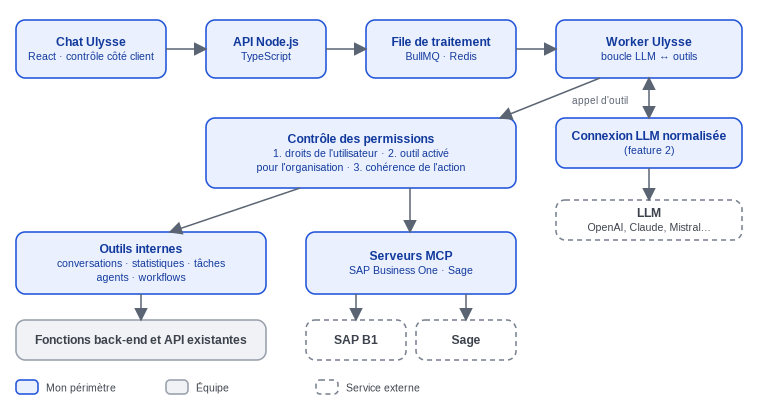
Ulysse diagram: the user, the LLM chatbot, the tool layer with permissions, back-end functions and MCP servers for SAP Business One and Sage
Diagram labels in French.
Stack
TypeScript, Node.js, React, LLM through the normalised connection, tool calling, MCP, BullMQ, Redis
My scope
Designed and built end to end: the chatbot, the tool layer, the permissions, the MCP servers, the workers and part of the tools. The other tools are written by the team under a shared convention: whoever creates a back-end function then creates the matching Ulysse tool.
Feature 2 · LLM connection

A normalised, multi-provider LLM connection

Context

Clients have different preferences: some want Claude, others ChatGPT, others a cheaper model. And each provider has its own API and format.

Goal

Pick the model per use case, based on quality and token cost, without touching business code. And let clients plug in their own LLM connection.

Solution

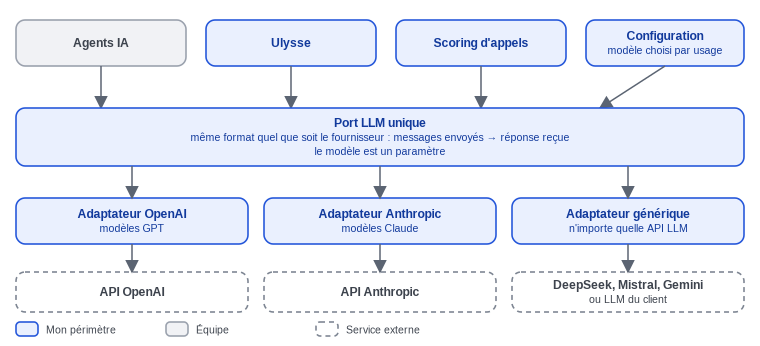
  • A single LLM port: whatever the provider, sending a message and receiving the answer always use the same format.
  • Three adapters behind this port: OpenAI for GPT models, Anthropic for Claude models, and a generic adapter that can connect to any LLM API (DeepSeek, Mistral, Gemini or the client’s own connection).
  • The model is a simple parameter, chosen per use case: for example Claude Sonnet for an agent and DeepSeek for Ulysse to cut token costs.
  • Agents, Ulysse and call scoring all go through this port: no component depends on a provider.
LLM connection diagram: product components call a single port backed by OpenAI, Anthropic and generic adapters
Diagram labels in French.
Stack
TypeScript, Node.js, ports and adapters, OpenAI API, Anthropic API, generic adapter for any LLM API
My scope
Designed and built end to end: the shared port, the single exchange format, the OpenAI and Anthropic adapters and the generic adapter.
Feature 3 · Channels

Six messaging channels connected to the AI agents

Context

Companies receive messages on many channels (social networks, messaging apps, email), each with its own API. They need to answer fast, in the right tone and within their opening hours.

Goal

Normalise conversations whatever the channel, so the AI agents can plug in, while keeping humans in control of the answers.

Solution

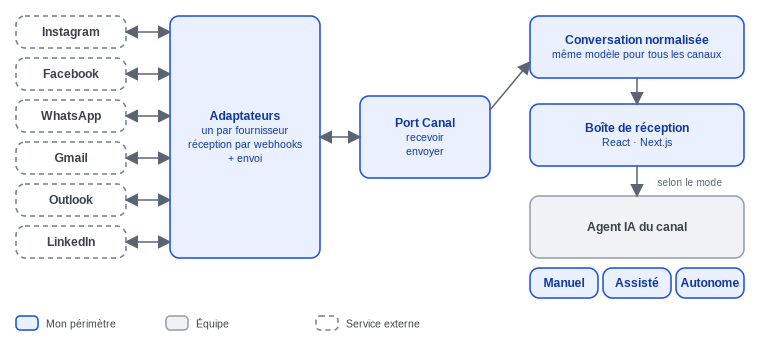
  • A "channel" port with two capabilities, receive and send a message, and one adapter per provider: Instagram, Facebook and WhatsApp (Meta), Gmail, Outlook, LinkedIn.
  • Inbound messages arrive through webhooks (or polling every 5 seconds when a provider offers none) and are converted into a single conversation model, centralised in one inbox.
  • Three modes, set per conversation for testing, then for the whole channel once the agent has proven itself: manual (a person answers), assisted (the agent drafts, a person validates) and autonomous (the agent answers alone).
  • Answers adapt to the channel (an email is not written like a WhatsApp message) and to the company: sector, tone, opening hours.
Channels diagram: six providers connected by webhooks to a channel port, a single conversation model, the inbox and the AI agent with three modes
Diagram labels in French.
Stack
TypeScript, Node.js, React, Next.js, ports and adapters, webhooks, Meta APIs (Instagram, Facebook, WhatsApp), Gmail, Outlook, LinkedIn
My scope
The whole channel layer, designed and shipped end to end, then connected to the AI agents. The agents themselves (model, context, persona, tools) were built by another team member.
Feature 4 · Call analysis

Analysing call campaigns automatically and following up with customers

Context

A large customer-relations client runs call campaigns for a telecom operator. A campaign has, for example, around a hundred 1- to 3-minute recordings, too many to review by hand.

Goal

Measure campaign quality automatically (resolution, satisfaction, churn risk, quality of handling) and follow up with customers whose problem is not solved.

Solution

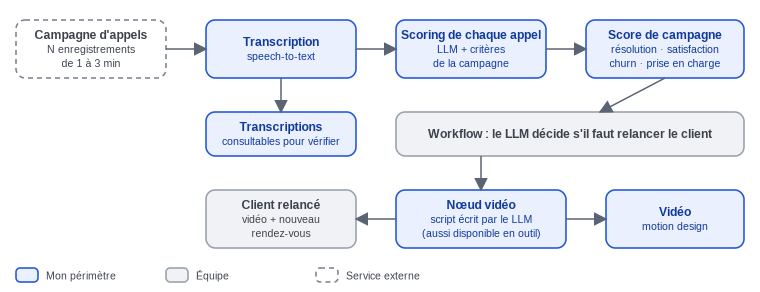
  • Speech-to-text transcription of every recording. Transcripts stay available to check the scoring.
  • Each call is scored by an LLM against criteria defined for the campaign, then a campaign score is computed: out of 100 calls, how many were resolved, how many customers are satisfied or at risk.
  • These steps are nodes in a workflow: based on the score, the LLM decides whether to follow up with the customer.
  • Video follow-up: the LLM writes the script, a motion design video is generated automatically and sent to the customer with a new appointment offer. Video generation is also available as a tool.
Pipeline diagram: recordings, transcription, LLM scoring, campaign score, follow-up decision and video generation
Diagram labels in French.
Stack
TypeScript, Node.js, speech-to-text, LLM through the normalised connection, workflow engine, motion design video generation
My scope
The analysis node (transcription, per-call scoring, campaign score) and the video node with its tool. The workflow engine and the LLM service that decides on follow-ups were built by the team.
Feature 5 · Desk

The internal chat that takes over when the AI stops

Context

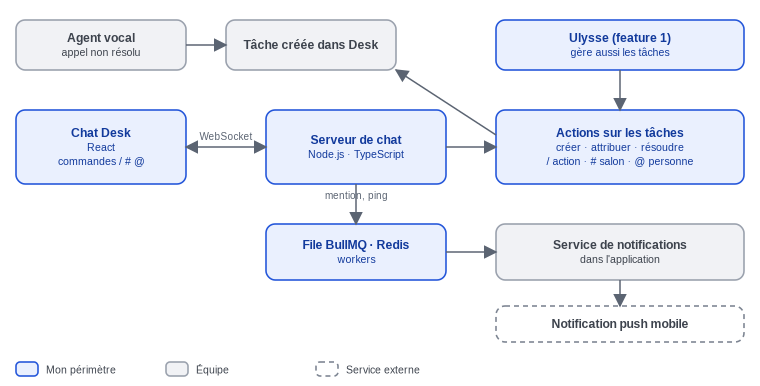
When the voice agent cannot resolve a call, it creates a task in Desk, Sairen’s task workspace. People then have to handle them, and until then they coordinated through external tools.

Goal

Let teams coordinate on tasks without leaving Sairen: discuss, hand a task over, resolve it, get notified when needed.

Solution

  • A Slack-style internal chat built into Desk, real-time over WebSocket between the React app and the Node.js server.
  • Commands in the chat: "/" triggers an action on a task (create, assign, solve), "#" mentions a channel, "@" mentions a person.
  • Mentions and reminders go through a BullMQ / Redis queue handled by workers, which feed the notification service: in-app and mobile push.
  • The same task actions are also available by chatting with Ulysse.
Desk diagram: the voice agent creates a task, the real-time WebSocket chat, commands, the BullMQ queue and the notification service
Diagram labels in French.
Stack
TypeScript, Node.js, React, WebSocket, BullMQ, Redis, workers, push notifications
My scope
The chat, designed and built end to end, front and back: real time, / # @ commands, task actions, sending mentions to notifications. The voice agent, the task model and the notification service were built by the team.

Other experience

Staymakom

01/2026 – 03/2026

Full-Stack TypeScript Developer · Experience booking: a new way to plan holidays, the experience first and the destination second. Platform shipped in 3 months.

  • Rebuilt from scratch in React / Next.js a platform that started as an AI-generated prototype with no tests or architecture: new database, git repository, full migration.
  • Search, availability and the journey through to online payment with Revolut, with an isolated test of the payment service to diagnose an incident within minutes.
  • Synced availability automatically with an existing PMS: if a sync step fails, the booking does not go through, so the platform never sells a slot that is not available.
  • Built 3 workspaces: customer, admin (experiences, bookings, refunds), hotel partner (sign-up and visibility).

TypeScript, Next.js, React, Node.js, REST API, PostgreSQL, Vitest

My scope · Sole developer, from design to production. MVP scope prioritised with the founder to ship in 3 months.

Read the case study

Butter

02/2025 – 12/2025

iOS Developer · Product Builder · The best restaurants in Paris in one app.

  • Launched and published the app from MVP to production: 14,000 users, 4.9/5 on the App Store, with no advertising budget.
  • Built the app in SwiftUI, with a business domain independent of the screens and Firebase.
  • Integrated Mapbox for maps, RevenueCat for subscriptions (20% premium conversion) and Amplitude for usage tracking.

Swift, SwiftUI, Firebase, RevenueCat, Amplitude, Mapbox

My scope · Sole developer: architecture, choice of services and app development. Firebase chosen to ship fast at MVP stage. The product was shaped by three people, with the two founders.

Read the case study

Groupe SYG Énergie

05/2024 – 02/2025

Full-Stack React / Node.js Developer · A construction and energy company managing many job sites, installers, sales reps and customers, which wanted all its processes in a single tool.

  • Delivered a business CRM (prospecting, signatures, job-site tracking) used by over 200 people.
  • One journey per role: management, sales reps, installers, back office, customers.
  • A management dashboard: job sites per stage, monthly revenue, installer costs, sales performance, bottlenecks.

TypeScript, JavaScript, React, Node.js, NestJS, SQL, Jest

My scope · Team project. Mine: the installer journey and part of the management dashboard.

Groupe Socoda

03/2023 – 06/2024

Full-Stack Developer / Data Engineer · A purchasing group for construction companies: each member gets an e-shop generated automatically from its product range.

  • Designed the database and import pipelines feeding 5 e-shops from 2 million supplier products.
  • A single pivot format: whatever file comes in (Excel, JSON, TXT), it is normalised then loaded by Talend jobs.
  • Matching against the reference product base (PIM) by EAN, or failing that by a brand + commercial reference key, then enrichment (images, sources) before the e-shop is created automatically.

MySQL, Talend, Node-RED, Metabase

My scope · Team of 3: I designed the import process end to end and built the pipelines with a second developer; the project manager tested and signed off.

Natixis (Groupe BPCE)

09/2021 – 03/2023

Full-Stack Java / Angular Developer

  • Built the REST APIs and interfaces of the group’s crypto platform, in a team of 15 working in scaled Agile (SAFe).

Java, Spring Boot, Angular, TypeScript, RxJS, JUnit

Education

2024
Full-Stack Developer master’s programme · Cloud Campus
2022
Bachelor’s in Digital Project Management · EEMI
2026
CNIL MOOC — GDPR workshop · 6 modules completed
Languages
French (native) · English (professional)